Refrigerator Repair
Sub-Zero Refrigerator Reset Button: The Resets That Really Exist
Most Sub-Zero refrigerators have no button marked reset: you reset one by switching it off at the control panel power key or the breaker, waiting a few minutes, then powering it back up. Here is which reset suits which symptom, and when a dark screen means a failed part.
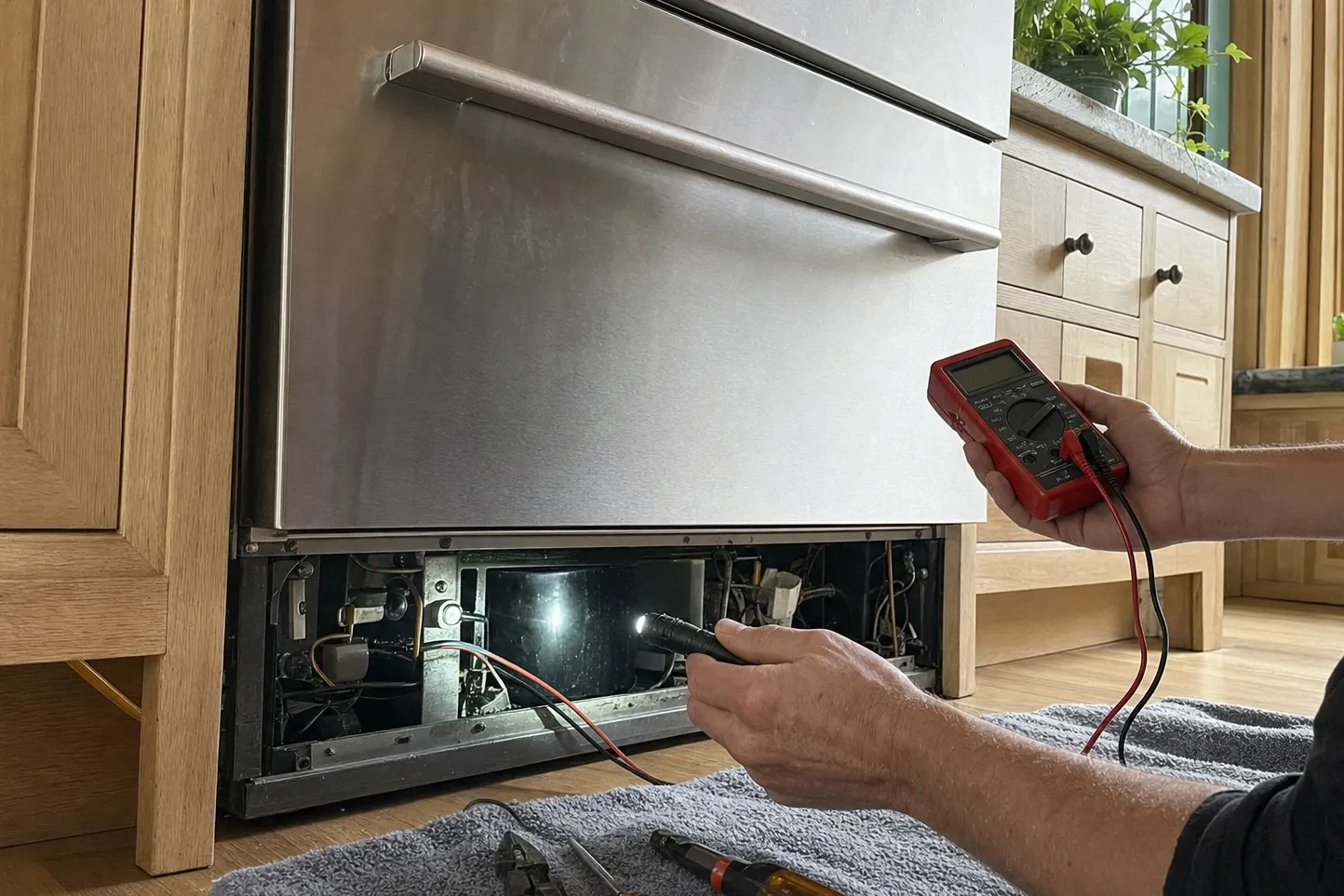
Most Sub-Zero refrigerators have no button marked reset. The reset is a power cycle: switch the unit off with the power key on its control panel, or turn its breaker off, wait a few minutes, then bring it back on and give it several hours to pull down to temperature. That clears a control board that got confused by a brownout, but it will not cure a dusty condenser, a mode that was left switched on, or a part that has failed. In a Phoenix kitchen where summer highs regularly top 110°F, guessing wrong costs a full load of food, so it pays to know which kind of reset fits the symptom in front of you.
Why a power cycle is the only true reset
The electronic control in a built-in Sub-Zero rides through most glitches, but a voltage dip during a storm can leave it stuck on a blank or garbled screen. Cutting power completely lets the board start again from nothing. On Classic (CL) and Designer (DET, DEC) units the control panel carries its own power key, and Sub-Zero treats that key as the normal way to shut the unit down. Its long-vacation routine, for example, is to switch off there, empty the cabinet, wedge the doors slightly open so the inside stays dry, and fit a fresh water filter before starting it up again.
If the panel will not respond at all, go to the breaker instead. Leave it off for a few minutes so the control and the compressor both settle, then switch it back on. Do not panic if the compressor stays quiet for a little while afterwards; many controls hold it back on purpose when power first returns. A cabinet that has warmed up can take most of a day to reach its set points, so judge the result the next morning rather than ten minutes later.
Check the supply before you blame the refrigerator
A unit that went dark by itself is often suffering from a power problem rather than a refrigeration one. Work through these in order:
- The breaker. Find the circuit labelled for the refrigerator. A tripped breaker usually rests in a middle position; push it firmly off, then back on.
- The circuit. For its Classic (CL) line, Sub-Zero calls for a 15 amp dedicated circuit supplying 115 VAC, 60 Hz, with a grounded three-prong outlet. A refrigerator sharing a circuit with other kitchen loads loses power every time that circuit trips.
- A GFCI outlet. Sub-Zero recommends against a GFCI on this circuit because it may interrupt normal operation. If a kitchen remodel put one behind the unit, that outlet could be the thing cutting out.
- The outage itself. When monsoon storms take the grid down, keep the doors closed. Sub-Zero says an empty unit typically needs about 3 hours before the fresh food section rises past 45°F (7°C) and the freezer past 20°F (-6°C). Frozen food that still has ice crystals in it, or that has stayed at 40°F (4°C) or colder, may go back in the freezer, although texture can suffer. Never taste anything to decide whether it is safe.
Modes that return after every outage
Sometimes the refrigerator powers up normally yet refuses to cool, or the ice simply stops, and no amount of switching off and on changes it. A stored mode is often the reason, because several of them are written to memory and survive a power failure.
Showroom Mode
Showroom Mode keeps the display and lights working for a store floor while the cooling stays off. A PRO 36 or PRO 48 left in Showroom Mode drops right back into it after an outage; you turn it off through the password-protected Service screen inside the Settings menu. On a Classic (BI), the display shows Sh r. To get out of it, turn the unit off with the Power key, keep one Warmer key and its paired Colder key held down while you tap Power once more, and only then lift your fingers off all three. On current Classic and Designer models, a screen reading 38° and 0° while the cabinet stays warm can mean the same mode is on, and Sub-Zero’s instruction in that case is to phone its customer care line.
Sabbath Mode
Sabbath Mode switches off the ice maker system and the door alarm and holds them off. It also comes back after a power cut, so an empty ice bin and a door that no longer beeps after an outage may just mean Sabbath Mode is still set.
Codes and alarms you can clear, and ones you should leave alone
Clearing a code is another kind of reset, but a few codes are warnings that ought to stay on the screen until the cause is dealt with.
| Display | What it means | What to do |
|---|---|---|
| EC50, Service flashing | Fresh food compressor running too long | Temperatures near normal: clean the condenser, then hold the bell key for 15 seconds. Temperatures high: book service. |
| EC40, Service flashing | Freezer compressor running too long, a door ajar, or a sealed system, fan or sensor fault | Reading under 10° above set: start with a condenser cleaning. Over 10° above and no door left open: arrange a service visit. Leave the code alone while temperatures climb. |
| Vacuum Condenser flashing | Running inefficiently or too warm | Clean the condenser, then switch the unit back on to reset it. |
| EE, Service or wrench flashing | A failed thermistor: left side is the freezer, right side the refrigerator | No owner fix; call for repair. |
EC40 is listed for units such as the 648PRO. Three of those four codes point at the condenser, and desert dust is a big part of why that matters here. After a summer dust storm, fine grit and pet hair can mat across the condenser behind the grille, and the system runs longer to keep up. With the power off, a soft brush and a vacuum nozzle clear it.
On a Legacy Classic (BI) that keeps chiming, a flashing wrench means a major code has been logged, while a steady wrench means a minor fault that is not threatening temperatures. To hush the chime for 24 hours, hold the ALARM key and the POWER key at the same moment and lift off before 5 seconds have passed. That buys quiet, not a repair; the fault is still sitting there.
When a dark display means a failed part
If the breaker is on, a lamp plugged into the same outlet lights up, and the control still shows nothing after a full power cycle, the trouble is inside the refrigerator. The likely culprits are the electronic control board or the wiring and connectors that feed it. Replacing a board typically costs $440–$870, and diagnosis confirms which piece has actually died before anything is ordered.
A lit display with weak cooling is a separate problem. Most built-in Sub-Zero models chill the fresh food and freezer sections with separate systems, so the refrigerator side can warm up while the freezer stays rock hard, or the other way round. A failed evaporator or condenser fan motor (typically $300–$660) or a defrost heater, thermostat or sensor ($280–$600) are frequent causes, and a compressor or sealed-system repair ($1,450–$3,120) sits at the expensive end. Our walkthrough of a fresh food side warming up in a Phoenix summer covers that pattern step by step.
Booking a diagnosis
When the resets above do not bring temperatures back, call (623) 240-9330 or use the booking button on this page. We work in Arcadia, Biltmore, North Central Phoenix and Ahwatukee. The visit is a flat $89 service call covering the trip and a complete diagnosis, and that $89 is credited toward the repair once you approve it. Every figure above is a typical span, and the firm quote follows once the technician has found the fault. More on the work we take on is on our refrigerator repair page.
Common follow-ups
- Where is the reset button on a Sub-Zero refrigerator?
- Most Sub-Zero refrigerators do not have a dedicated reset button. You restart the control by turning the unit off with the power key on its control panel, or at the breaker, leaving it off for a few minutes and switching it back on. Allow several hours before judging whether it is cooling properly again.
- Why is my Sub-Zero refrigerator not cooling when the freezer still works?
- Built-in Sub-Zero units usually cool each section with its own system, so one side can fail on its own. A stopped evaporator fan, a defrost fault that has iced over the fresh food coil, or a dusty condenser are common causes. If a condenser cleaning does not help within a day, book a diagnosis.
- Will a power cycle clear Showroom Mode or Sabbath Mode?
- No, both modes come straight back once power returns. Showroom Mode on a PRO 36 or PRO 48 is switched off through the password-protected Service screen in Settings, and a Classic (BI) has its own key sequence. Sabbath Mode, which keeps the ice maker and door alarm off, also resumes after an outage.
- Can I keep resetting my Sub-Zero to make EC40 go away?
- No, Sub-Zero advises against clearing EC40 while temperatures are still rising. Clean the condenser if the reading is under 10° above set; if it is more than 10° above and nobody left the door open, the fan, sensor or sealed system needs a technician to look at it.
- What does a Sub-Zero diagnosis visit cost in Phoenix?
- The visit is a flat $89 service call that includes a full diagnosis, and that amount is credited against the repair once you approve the work. The repair itself is quoted firmly only after the fault is found; an electronic control board, for example, typically costs $440–$870.