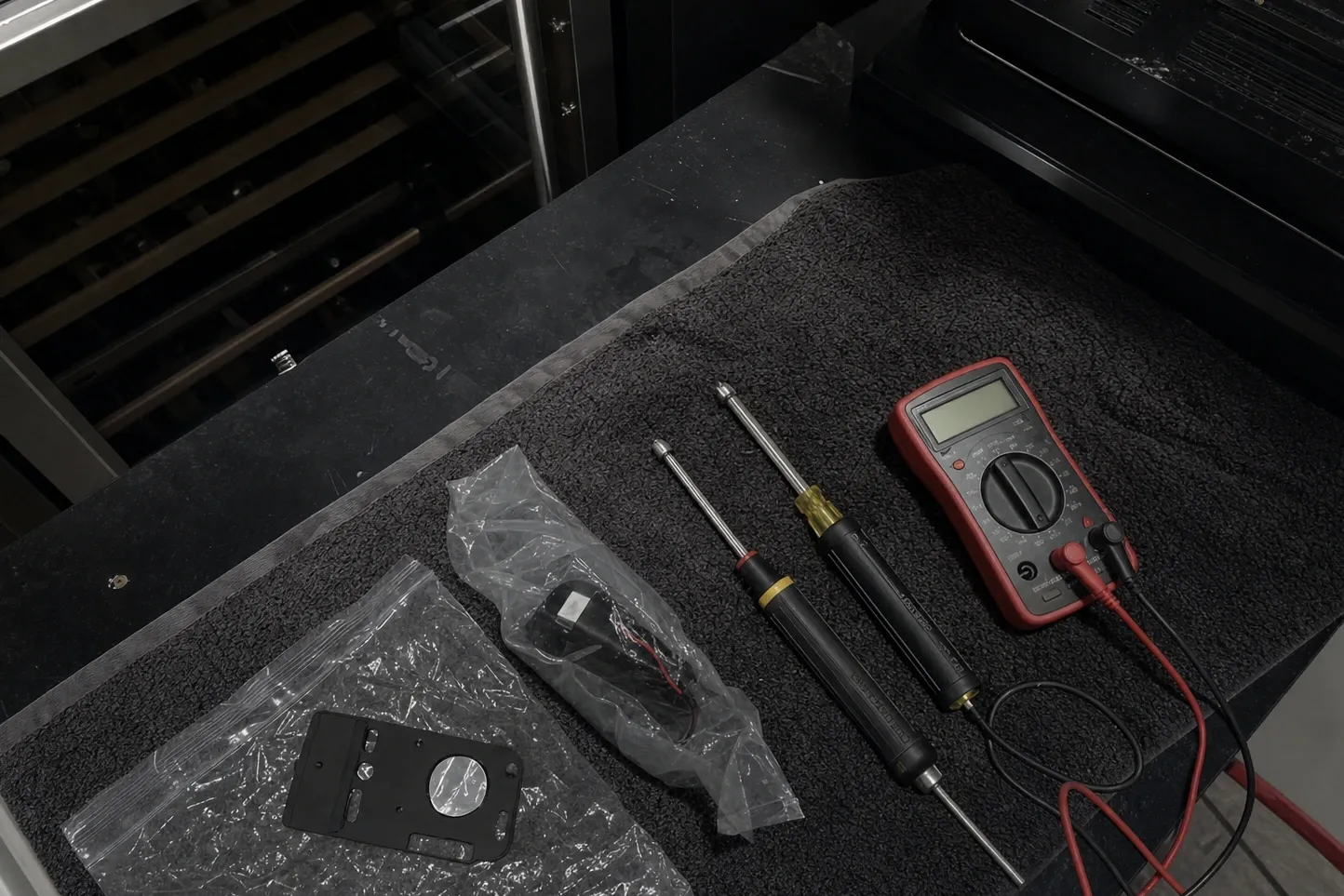
Refrigerator Repair
Irrigation Day in Arcadia: What Canal Water, Silt and Citrus Litter Do to a Built-In Sub-Zero
On a flood-irrigated Arcadia lot, a built-in Sub-Zero fails from two directions at once: canal silt and citrus litter packing the base-grille intake and condenser, and irrigation water reaching the units parked in garages and rear utility rooms.
The question worth asking first
Ask where the water goes on your lot before asking what is wrong with the refrigerator. Arcadia and parts of the North Central Phoenix corridor are still watered by Salt River Project flood irrigation, delivered out of the Arizona Canal through neighbourhood laterals to a gate or a box on each property, and the appliance in trouble is usually downhill of it.
That arrangement is an inheritance from a citrus district. The Arcadia Water Company was founded in 1919, and by 1924 it had put several pumping stations and roughly fifteen miles of concrete pipe under the neighbourhood. Citrus was farmed there from about 1919 until the mid-1950s, when the groves were subdivided into the ranch houses that stand today. The trees came out; the delivery system, the surviving canopy and the deep lots did not go with them.
So the honest first question on a service call in Arcadia is not “what part failed” but “which unit are we talking about, and where does it live”. The kitchen column in a remodelled ranch house is usually the healthiest appliance on the property. The one that fails early is the second one: the overflow refrigerator on the garage slab, the freezer in the back utility room, the wine storage that got pushed out of the kitchen during the remodel.
What shortens an appliance life here specifically
Two things, and on an irrigated lot they arrive on the same afternoon. Standing canal water crosses the yard and settles on the low side of the building, which is typically the garage floor and the rear utility room. The same water carries silt, and the mature citrus and eucalyptus that these lots support shed litter and pollen the rest of the year.
The airside half of that is what we see most. A built-in Sub-Zero breathes through the base grille, and everything the yard produces gets drawn straight into the intake, the air filter and the condenser fins. A packed fin face cannot shed heat properly, and it performs at its worst in the weeks when Phoenix demands the most of it. Head pressure climbs, the compressor stops cycling off, the condenser fan runs loud and constant, and the fresh food compartment drifts up into the fifties while the freezer side still feels hard. Owners read that split as a thermostat problem. It is almost always an airflow problem with a thermostat-shaped symptom.
The waterside half is slower and uglier. Silt dries to a grey film across the compartment floor, and moisture that sits under a machine that runs warm attacks what it can reach: fan motor bearings, terminal connections, fasteners, the underside of the compressor compartment. A unit that has taken irrigation water for ten years does not fail dramatically. It accumulates small electrical faults.
None of that describes Biltmore or Ahwatukee. Condos and patio homes along the Camelback Corridor and family houses at the foot of South Mountain sit on landscaped or granite lots with no flood delivery at all. They foul too, but with fine desert dust and patio heat rather than leaf litter and standing water, and the corrosion pattern is absent.
Reading the machine you already own
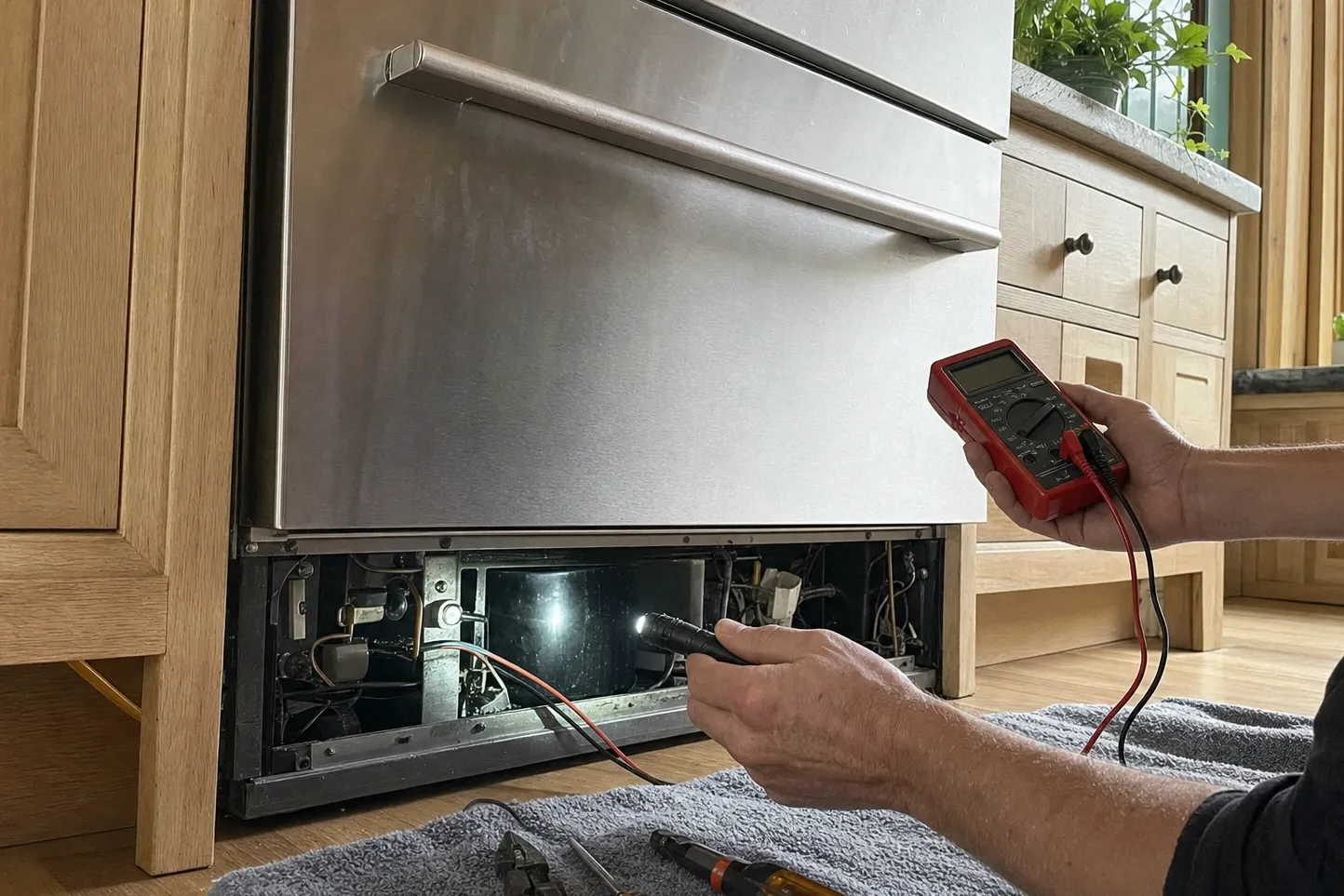
Pull the base grille off and look at the face of the condenser before you touch a single control. A fin face packed grey, a silt line along the floor of the compartment, or a filter you cannot see daylight through will explain most warm-fresh-food complaints on an irrigated lot, and finding it takes no tools at all.
Work it in this order. Look at the fin face and the intake, then the air filter. Then watch the condenser fan: it should spin freely by hand with the power off, with nothing wound into the shroud. Then check the floor of the compartment for a dried silt line, water staining or the white bloom of corrosion around terminals and motor housings. Then put your own thermometer in a glass of water on a middle shelf and read it after several hours rather than trusting the panel. Finally, close the door on a sheet of paper and pull: a vacuum door seal that has stopped grabbing is a separate fault that makes everything above look worse.
If the fins are clean, the filter is clear, the fan turns and the fresh food side is still warm, the fault is inside the sealed system or the defrost circuit, and it needs gauges. That is the point at which guessing gets expensive.
Repair, or start again
The fouling repairs are the cheap ones; the consequences of leaving them are not. Fan motor work — condenser or evaporator — runs $300 to $660 here. Replacing a door gasket or seal is $270 to $620. The defrost heater, thermostat and sensor group falls between $280 and $600. Ice maker, water valve or supply line work comes in at $270 to $770, and an electronic control board at $440 to $870.
The number that decides things is the sealed system: $1,450 to $3,120 for compressor or sealed-system repair. A twenty-year-old garage unit that has spent those years pulling citrus litter through a blocked grille in Phoenix summers is exactly the machine that arrives at that quote, and for a secondary appliance the arithmetic often points at replacement. For a kitchen column in Arcadia or North Central Phoenix, where the cabinetry was built around the unit and the panels are custom, the same quote usually points the other way.
What we will not do is put that decision on you without evidence. If it is a sealed-system diagnosis, you get the readings behind it.
What a diagnosis gives you
A diagnostic visit is $89. That buys the base-grille and condenser inspection, temperature readings taken at the compartments rather than off the display, a check of the fans, defrost circuit and door seals, and a look at the compressor compartment for the corrosion and silt that only irrigated lots produce.
What you receive at the end is a named fault, the parts it needs, the band it falls in, and a straight answer on whether the machine is worth the money. If the real problem is that a grille clean-out after each irrigation season would have prevented the whole thing, we will tell you that too — it is the least profitable sentence we can say and the most useful one.
(623) 240-9330 during opening hours; the booking link works whenever you do.
Common follow-ups
- Does flood irrigation actually reach my refrigerator, or does it just soak the yard?
- On an irrigated Arcadia lot the water crosses the whole yard and settles on the low side of the building, which is usually the garage slab or a rear utility room. If a second refrigerator, a freezer or a wine unit lives in either of those, the water reaches the floor of the compressor compartment. The kitchen column, sitting higher and indoors, generally does not see it.
- How often should the condenser be cleaned on a Sub-Zero in Arcadia?
- More often than the manual assumes, because the manual was not written for a lot with mature citrus and eucalyptus standing over it. A practical rhythm is to pull the base grille and inspect the fin face and the air filter after each irrigation cycle, then again at the end of the pollen-heavy months. If daylight still passes through the fins, leave it alone.
- The freezer is fine but the fresh food side is warm. Is that the thermostat?
- Rarely. On a built-in Sub-Zero that split normally means the machine cannot shed heat or cannot move air, so the freezer holds while the fresh food compartment climbs. In Arcadia and North Central Phoenix the first suspect is a blocked base-grille intake with a packed condenser behind it, then the evaporator fan, then the defrost circuit. A control sits near the end of that list, not the beginning.