Ice Maker Repair
Cloudy, Hollow and Fused Cubes: Phoenix Water in a Sub-Zero Ice Maker
Slow production, chalky cubes and a lump of ice in the bin are usually water and scale rather than a failed clear-ice module. How to tell which one you have before anyone orders a part.
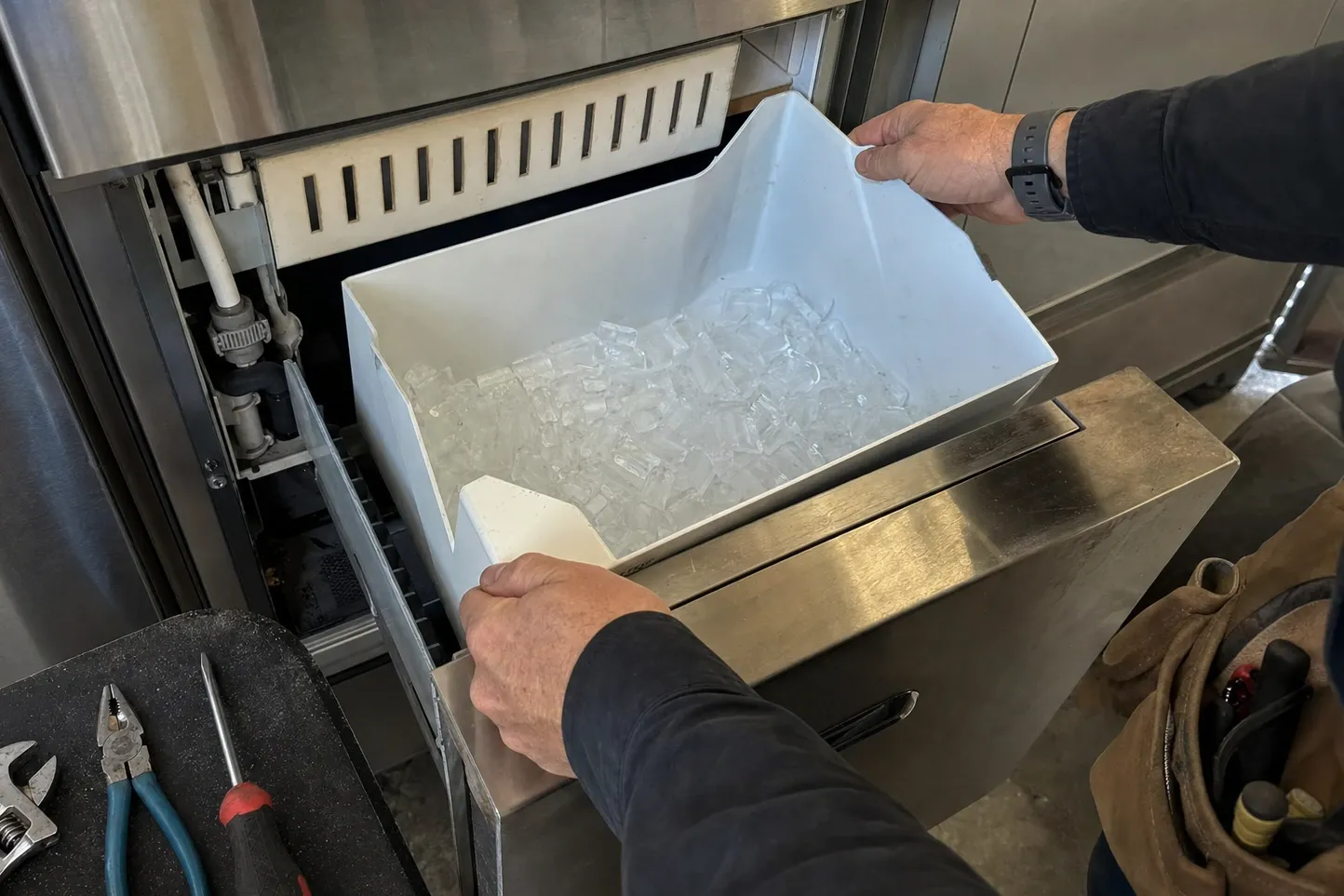
Phoenix water is hard, and an ice maker is the appliance in the house that argues with that fact most visibly. Cubes come out chalky white instead of clear. They come out hollow, like shells, and shatter in a glass. Production falls from a full bin to a handful of cubes a day. Or everything welds into one lump that has to be broken up with a spoon.
All four of those get diagnosed over the phone as a dead ice maker, and all four are usually something else. On a clear-ice system the module — the part that freezes and harvests — is one of the more reliable pieces of the machine. What arrives at it, and what has built up on it, is where the trouble almost always lives.
Hollow cubes mean the mould ran short of water
A hollow or undersized cube froze what water it had from the outside inwards and harvested early. That is not a freezing problem. That is a fill problem, and it points upstream in a fixed order: the filter first, then the inlet valve, then the supply line, then household pressure.
Filters are the common one, and not because people neglect them — because a filter in this water reaches the end of its useful life sooner than the label suggests. An inlet valve that no longer opens fully produces the identical symptom and needs a meter to separate from a tired filter. A supply line kinked behind the unit after it was last pushed back into its cabinet is rarer, but it costs nothing to rule out.
The reason this matters is money. Replacing the module because the cubes are hollow gives you a new module producing identically hollow cubes, because it is being fed the same short fill.
Cloudy is a different problem from hollow
Cloudiness is about what is in the water and how fast it froze, not how much of it arrived. Clear ice is made slowly, in layers, so that dissolved air and minerals are pushed out as it forms. Freeze the same water faster, or freeze water carrying more mineral than the system was designed around, and the cloud stays in the cube.
So a chalky cube usually means one of two things here: the water is heavily mineralised and the filter is past it, or the freeze cycle has been shortened by scale on the mould so the layering never happens properly. Those two travel together often enough that it is worth treating them as one job.
Scale on the mould, and what descaling actually does
Take the cover off and look at the mould. On a machine that has been running on unsoftened water for a few years you will find a dull crust in the pockets and along the fingers. That crust does three things: it insulates, so the freeze takes longer; it holds the cube, so harvest is slow and wet; and it throws the timing out, because the system decides when to harvest from temperature.
Descaling is not glamorous and it is not a parts sale. It is the cheapest thing that can be done to a struggling ice maker in this city, and on plenty of machines it is the whole repair. It also has to be done properly and rinsed properly — a mould left with cleaner in it makes ice nobody wants to drink.
Meltwater, drains and the lump in the bin
Cubes fused into a solid mass, a ridge of ice growing on the freezer floor, or a wet bin are drain and defrost problems rather than production problems. Every ice maker sheds a little meltwater. It has to leave.
When the drain is restricted, that water sits, refreezes and cements the bin together. On undercounter machines with a drain pump, the pump and the bin sensor are both worth reading before anything gets ordered, because a pump that has stopped and a sensor gummed up with scale produce complaints that sound the same from the other side of a phone call.
There is also a plain mechanical cause worth checking first: a fill tube dribbling past the mould instead of into it. That drips into the bin every cycle and freezes there, and adjusting it takes minutes.
What to check yourself, and what to leave
Change the filter and flush a few gallons through the line. Confirm the shut-off valve behind or below the unit is fully open. Empty the bin completely, check that nothing is holding the bin sensor or the fill tube out of position, and give the machine a full day from empty before judging it.
Leave the mould crust alone if it needs anything more than a wipe, leave the inlet valve to a meter, and leave the drain pump alone. When you call, the useful things to have ready are the model number, roughly how much ice it is making in a day, whether the cubes are hollow or cloudy or both, and when the filter was last changed. That short list is most of the diagnosis, and it decides which parts come out on the van rather than which parts get ordered afterwards.
Common follow-ups
- How long should a Sub-Zero ice maker take to fill an empty bin?
- Roughly a day on a healthy machine, longer in high summer because the water arriving at the mould is warmer. If a bin is taking several days with good supply pressure, something is restricting the fill or slowing the freeze.
- Will a new filter fix cloudy ice on its own?
- Sometimes, if the cloudiness is coming from what is dissolved in the water. It will not fix hollow cubes, because those are a fill-volume problem, and it will not remove scale that has already built up on the mould.
- Is a whole-house softener worth it for the ice maker?
- It reduces how fast scale returns, which is the main reason a mould needs cleaning again. It is a plumbing decision rather than a repair, and it does not replace a filter at the machine — the two do different jobs.